

Surgical Recovery of NVIDIA Blackwell RTX PRO 5000 (72GB)
CASE STUDY: Surgical Recovery of NVIDIA Blackwell RTX PRO 5000 (72GB)
Project Lead: AKM Repairs
Fault: Critical Power-Stage Failure (No Power / Overcurrent Trip)
Architecture: NVIDIA Blackwell GB202
- Executive Summary
A high-value RTX PRO 5000 Blackwell workstation card was submitted to our lab following a catastrophic system shutdown. The client reported an audible “pop” and a scent of burnt plastic, followed by a total failure of the GPU to initialize.
- The Forensic Diagnostic
Despite the client’s report of a “burnt smell,” a microscopic visual inspection revealed a pristine PCB. This is a hallmark of high-end enterprise boards; the thick copper layers and high-quality substrate often mask internal component failures.
- Primary Fault Discovery: Using precision voltage injection on the 12V rail, we identified a dead short to ground within the PEX DrMOS (Driver MOSFET) array.
- The “Silent” Failure: The DrMOS had failed internally. While it didn’t char the board, it was effectively acting as a “crowbar” across the power rail, preventing the GPU’s PWM controller from starting the boot sequence.
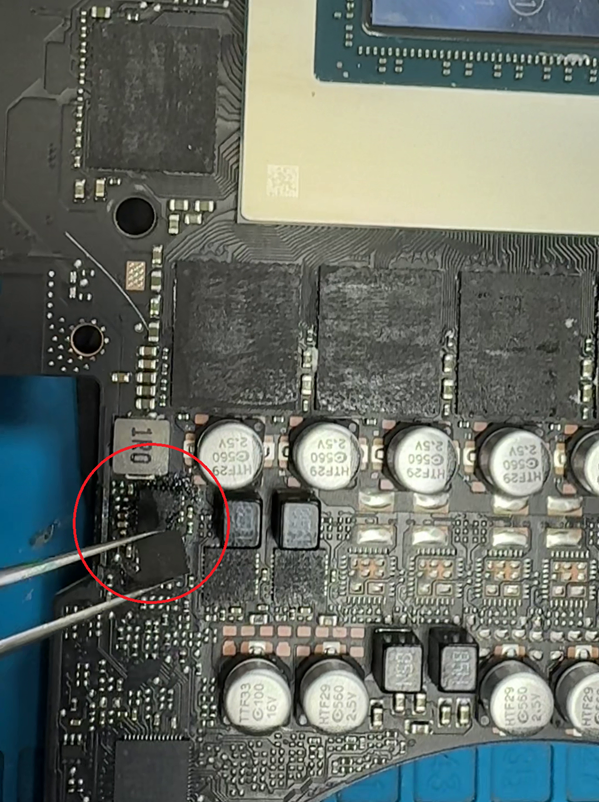
Blackwell RTX PRO 5000
Architecture Insights: The 96GB Connection
During the teardown, our team performed a detailed mapping of the Blackwell GB202 PCB. A significant observation was made regarding the VRAM configuration:
The 72GB PRO 5000 utilizes a specific memory density that leaves several VRAM pads unpopulated. These empty pads (8x 3GB) confirm the shared PCB DNA with the upcoming 96GB flagship variants, highlighting NVIDIA’s modular approach to the Blackwell enterprise line.


The Repair Process
- Component Level Micro-Soldering: The faulty DrMOS was removed using a calibrated IR pre-heat and hot-air station to avoid thermal shock to the surrounding GDDR7 memory modules.
- Trace Integrity: We verified that the surge had not reached the GPU core or the high-speed data lanes.
- Replacement: A new, high-spec DrMOS was bonded, and the thermal interface material (TIM) was replaced with industrial-grade phase-change material to ensure longevity under 24/7 AI workloads.
Validation & Testing
Repairing an AI card isn’t finished until the data integrity is proven. The card underwent:
- PCIe Lane Training: Verified at full Gen 4/5 bandwidth.
- VRAM Stress Test: OCCT, FurMark, 3DMark and Heaven to ensure the GDDR7 modules remained stable under high thermal loads.
- Power Draw Analysis: Monitored to ensure the new power stage balanced perfectly with the existing phases.
- Tested in Real Gaming Environment: Cyberpunk 2077 benchmark and real time gaming.
Conclusion
The RTX PRO 5000 was returned to the client in full working order. This case proves that even the most advanced NVIDIA Blackwell hardware is serviceable at the component level when handled with the correct forensic equipment and architectural knowledge.
For more information about our services, please explore our B2B GPU repair solutions, standard GPU repair services, and specialised AI & enterprise GPU repair capabilities.
#NVIDIA #Blackwell #GPUrepair #AIInfrastructure #RTX5000 #AKMrepairs #MicroSoldering
Watch the short video of the NVIDIA Blackwell PRO 5000 as it comes back alive…
Stay up to date with AKM Repairs by visiting our News section, where we share interesting stories about our latest repairs, company updates, and innovations from GPU and electronics manufacturers. You’ll find behind-the-scenes looks at challenging fixes, tips to keep your devices running at their best, and announcements about new services we offer.
Don’t forget to connect with us on X (Twitter) and Facebook for quick updates and customer highlights. For repair demos and detailed insights, watch our latest shorts and videos on our YouTube channel and make sure to subscribe so you never miss what’s new!